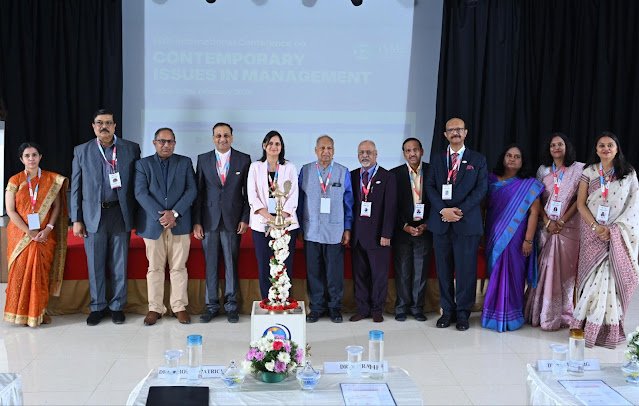

Bengaluru,
25 February 2026 : The International School of Management Excellence (ISME)
hosted the International Conference on Contemporary Issues in Management (CIM
2026), focusing on the intersection of artificial intelligence, research
ethics, and industry-ready methodologies. The event honored Dr. T.V. Rao, a
renowned HRD pioneer, with the Lifetime Achievement Award.
Dr.
Rao emphasized the importance of human judgment in AI-driven research, stating,
“AI can do almost everything we can do and often faster. But it cannot
deal with the unforeseen. We should use AI, but we should not become dependent
on it.”
His
message resonated through panel discussions and session summaries that examined
how rapidly evolving technology is reshaping research practices in management
education.
Dr.
Nitin Garg, Funder, Director, ISME highlighted the encouraging quality of
submissions. “The credibility of any conference lies in both the number and
quality of papers. It is heartening that many student papers presented here are
of publishable standard,” he said, outlining three pillars of strong research:
a compelling problem statement, robust methodology and a rigorous literature
review.
Key
Takeaways from CIM 2026:
AI
is an enabler, not a replacement- Speakers acknowledged that AI tools have
simplified literature reviews, data organisation and even classroom preparation.
However, concerns were raised about unverified outputs, fabricated references
and rising plagiarism risks. With some institutions now requiring disclosure of
AI usage in research submissions, the consensus was clear: use AI for
assistance, but validate, contextualise and articulate independently. As one
panelist remarked, “AI provides information. Knowledge still requires critical
thinking.”
Ethics
will shape the future of research- Beyond technical capability, ethical
application emerged as a central theme. Discussions focused on maintaining
originality in academic writing and ensuring transparency in AI-assisted
research. Faculty members emphasised that supervisors must guide students in
balancing technological efficiency with academic integrity.
Student
research is becoming more sophisticated- Session chairs observed a notable
shift in methodology. While earlier conferences saw heavy reliance on tools
such as ANOVA and regression, this year’s papers incorporated structural
equation modelling (SEM), confirmatory factor analysis (CFA), and machine
learning models including Random Forest and XGBoost.
Bridging
academia and industry expectations- A recurring observation was the need to
align research more closely with industry applications. While multivariate
techniques remain academically valuable, industry professionals increasingly
rely on applied analytical tools such as conjoint analysis, MaxDiff and turf
analysis to inform product and strategy decisions.
Panelists
argued that equipping students with such real-world analytical frameworks would
narrow the academia–industry gap and improve employability outcomes.
Conference
themes reflect market evolution.
Dr.
Pallavi Garg, Director, Admissions and External Relations, ISME noted that
while the overarching theme of “contemporary issues” remains constant, the
focus areas evolve annually. “We have moved from logistics and supply chain
discussions to fintech, digital finance and AI. The title remains the same, but
the themes keep renewing themselves,” she said, adding that educators must
prepare students for roles that may not yet exist.
As
CIM 2026 concluded, the Lifetime Achievement Award to Dr. T.V. Rao symbolised
the enduring values of scholarship rigor, integrity and human-centred thinking
even as the tools of research evolve.
The
overarching message from the conference was clear: artificial intelligence may
accelerate research, but its credibility and impact will depend on ethical use,
methodological depth and meaningful industry alignment.