
In
today’s corporate environment, authority is no longer defined by title alone.
It is defined by influence.
Organisations
are operating in an era of constant transformation — digital acceleration,
stakeholder activism, cross-functional complexity, and heightened scrutiny. In
such an environment, the ability to communicate with clarity, command
attention, and inspire confidence has become a decisive professional advantage.
Yet
many senior professionals encounter a recurring challenge: expertise and
experience do not automatically translate into gravitas.
They
may manage high-performing teams and oversee critical portfolios. But in
high-stakes discussions — where strategy is debated and decisions are shaped —
influence often rests with those who project composure, credibility, and
narrative clarity.
Executive
presence is no longer a cosmetic attribute. It is professional infrastructure.
Increasingly,
boards and CXOs expect senior professionals to articulate strategy with
precision, influence without formal authority, navigate complexity with
maturity, and represent their organisations with conviction.
It
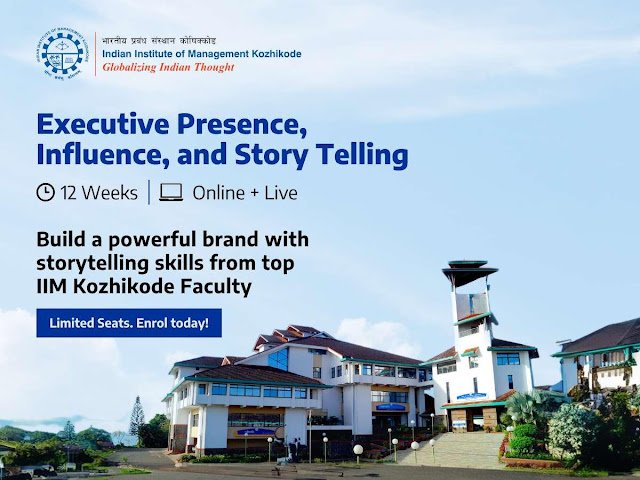
is within this context that IIM Kozhikode’s Executive Presence, Influence, and Storytelling
Programme has gained significance.
From
Competence to Command
Professional
advancement traditionally emphasised domain mastery and operational excellence.
Today, those remain essential — but insufficient.
Modern
corporate environments require the ability to:
●
Influence informally across hierarchies
●
Communicate vision with clarity and conviction
●
Build strategic networks that expand impact
●
Shape persuasive narratives in real time
●
Manage critical conversations with composure
Executive
presence is not about performance. It is about alignment — between intention,
communication, and perception.
The
Executive Presence, Influence, and Storytelling Programme at IIM
Kozhikode is structured around this progression: from
technical credibility to influence-driven authority.
Delivered
over 12 weeks in a flexible online format, the programme combines structured
pre-recorded modules with live masterclasses by faculty at IIM Kozhikode and
interactive debriefing sessions facilitated by experienced practitioners. With
a weekly commitment of 5–6 hours, participants strengthen executive capability
without interrupting their careers.
The
objective is not personality transformation. It is strategic refinement.
Influence
in Action: Tools That Translate to the Boardroom
The
programme moves beyond theory to actionable frameworks that professionals can
apply immediately.
1.
Informal Influence
Participants recognise the often-invisible factors shaping their
ability to create impact — credibility signals, behavioural cues, and
relationship capital. They learn how influence operates outside formal
reporting lines and how to strengthen it intentionally.
2.
Communication of Vision
Rather than simply presenting information, participants develop a
clear narrative for their professional trajectory and organisational
contribution. They use this “future-self vision” to structure communication
that aligns ambition with strategy.
3.
Informal Networks
Strategic visibility depends on diversified networks. The programme
equips participants with techniques to expand influence beyond immediate
circles, strengthen cross-functional relationships, and cultivate trust across
stakeholder groups.
4.
Narrative Building
In an environment saturated with data, persuasion depends on
storytelling. Participants learn how to construct compelling narratives that
simplify complexity, align stakeholders, and drive decisions.
5.
Framework for Persuasion
Through structured models, participants understand the foundations of
effective persuasion — how to frame arguments, anticipate resistance, and
influence outcomes with integrity.
These
actionables are reinforced through applied exercises, case illustrations, and
guided reflection — ensuring that executive presence becomes a practised
discipline rather than an abstract aspiration.
A
Structured Development Architecture
The
curriculum is organised across
four integrated pillars:
●
Executive Presence Foundations
— self-awareness, behavioural alignment, gravitas, and credibility.
●
Communication and Strategic Storytelling
— verbal and non-verbal communication, persuasive structures, and narrative
clarity.
●
Networking and Personal Branding
— emotional intelligence, resilience, reputation management, and strategic
relationship-building.
●
Managing Critical Relations and Ethical
Perspective — adaptive behaviour, stakeholder engagement,
cross-cultural sensitivity, and integrity in influence.
Together,
these pillars address a central reality of modern organisations: influence must
be earned consistently across interactions, not assumed through designation.
The
Evolving Mandate of Executive Development
As
corporate environments grow more complex, visibility intensifies. Senior
professionals are expected to represent strategy internally and externally,
navigate ambiguity confidently, and communicate direction under pressure.
In
such settings, executive presence becomes measurable through outcomes —
alignment achieved, trust built, decisions influenced.
IIM Kozhikode’s Executive Presence, Influence, and Storytelling
Programme reflects this evolving mandate. By combining
academic rigour with applied frameworks, it equips professionals to shape
perception intentionally and translate experience into impact.
In
competitive and high-visibility environments, influence is not incidental.
It
is cultivated.
And
those who invest in strengthening it, position themselves to participate in
critical conversations with greater clarity, composure, and credibility.