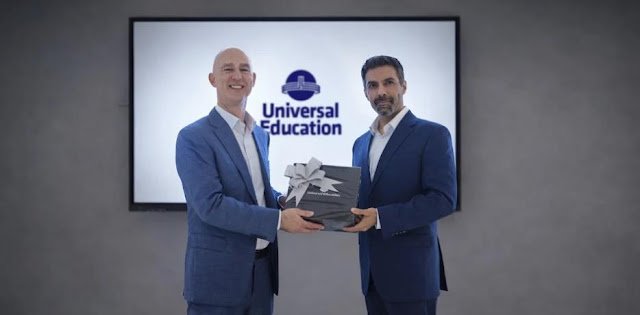

Mumbai : In a significant step toward
strengthening global education pathways for Indian students, Dr. Mike Magee,
President of Minerva University, recently visited India to meet Mr. Jesus
Lall, Chairman of Universal Education, sparking conversations around the
future of higher education, global learning models, and new opportunities for
Indian learners seeking international careers.
The visit focused on how emerging
education systems are moving beyond traditional classrooms toward
skills-driven, globally immersive learning experiences — a model Minerva
University has pioneered over the past decade. At the same time, the
discussions reflected Universal Education’s growing emphasis on
interdisciplinary learning, digital integration, and preparing students for a
borderless future.
A Shared Shift in Educational Thinking
Across the world, higher education is
undergoing structural transformation. Employers are placing increasing value on
analytical thinking, adaptability, collaboration, and real-world execution,
skills that are not always cultivated through conventional lecture-based
instruction.
Minerva University has built its academic
model around this shift. Instead of large lecture halls, the institution
operates on a structured active-learning framework. Students prepare in
advance, participate in small interactive seminars, and apply concepts
immediately through real-world assignments. Classes are intentionally limited
to fewer than 20 students to ensure depth of engagement and personalised
faculty interaction.
The pedagogy emphasises advanced
preparation, discussion-based learning, and practical application, ensuring
that knowledge is not passively consumed but actively constructed and tested.
For Universal Education, such models
resonate strongly with its own evolving academic philosophy.
Universal Education’s Expanding Ecosystem
Over the past decade, Universal Education
has developed a diversified education network spanning schools and higher
education institutions, including B.Ed. & Law colleges, along with a fully
operational SkillTech University. Universal has increasingly focused on
technology-enabled classrooms, interdisciplinary curriculum structures, and
industry-aligned programmes that bridge academic theory with professional
practice. Universal SkillTech University offers industry-relevant courses in
association with the Retailers Association of India (RAI), Emversity, and
byteXL (in collaboration with Microsoft), further strengthening its emphasis on
applied and career-linked learning.
Its approach integrates digital
infrastructure, collaborative learning environments, and structured mentorship
to prepare learners not only for examinations but for long-term career
pathways. With growing emphasis on skill-building, global exposure, and applied
learning, Universal Education has positioned itself as an institution seeking to
align Indian education with international standards.
The meeting with Minerva’s leadership
reflects this broader institutional direction — one that recognises that
education must evolve alongside global economic shifts.
A Global Academic Structure Across Cities
One of Minerva’s distinguishing features
is its global rotation model. Undergraduate students live and study across
multiple world cities during their degree, including San Francisco, Berlin,
Buenos Aires, Seoul, Taipei, and previously Hyderabad.
Learning is embedded within each local
context. Students engage with civic institutions, businesses, and community
organisations, applying academic frameworks to real-world challenges. The
curriculum integrates foundational interdisciplinary courses, major
specialisations, electives, and capstone projects anchored in applied
assignments.
Such global mobility reflects an
education design built for international careers, where cultural fluency and
contextual understanding are as critical as subject expertise.
For Indian students, exposure to such
models represents an expansion of what higher education can look like, moving
beyond static campuses to dynamic global engagement.
Preparing
Graduates for a Changing Economy
Graduates from Minerva University have
progressed to organisations such as Google, BCG, and the World Bank, while
others have secured postgraduate placements at Oxford, Stanford, and Harvard.
The institution embeds internships, applied projects, and career coaching
within the student journey.
Minerva’s academic standing has also been
reflected in the 2026 Niche rankings, where it placed #3 among the hardest
colleges to get into in America, #15 for best colleges for business, #17 for
best colleges for mathematics, and in the top 3 per cent nationally for
academics and student life — underscoring both selectivity and student
experience.
These outcomes align with broader
labour-market trends. Increasingly, employers seek graduates who can navigate
ambiguity, collaborate across cultures, and apply structured thinking to
complex problems.
Universal Education’s Chairman, Mr. Jesus
Lall, underscored this alignment during the discussions.
“Indian students deserve access to
education that prepares them not just for degrees, but for leadership in a
rapidly changing world. Conversations like these help create pathways that
connect Indian ambition with global opportunity,” he said.
Dr. Mike Magee added, “The future belongs
to learners who can think critically, adapt globally, and solve real problems.
India has extraordinary talent, and education models must evolve to unlock that
potential on a global stage.”
Accessibility and Financial Considerations
A key discussion point during the visit
was financial accessibility. Minerva operates on a need-based financial aid
system, with approximately 83 per cent of students receiving some form of
assistance through scholarships, grants, and structured aid packages.
As Indian families evaluate international
education pathways, affordability and transparency in financial planning remain
central considerations. Conversations around accessibility, therefore, formed
an important part of the broader dialogue on expanding global opportunities.
Universal Education’s leadership
emphasised the importance of ensuring that global pathways remain inclusive and
merit-driven, rather than limited by geography or financial constraints.
Why This Dialogue Matters
India’s demographic advantage, combined
with increasing global mobility, places the country at a strategic crossroads.
As artificial intelligence reshapes industries and interdisciplinary careers
become more common, education systems must prioritise flexibility, analytical
reasoning, and cross-border competence.
Engagements such as this signal a growing
alignment between Indian education leaders and global innovators in pedagogy.
Rather than focusing solely on institutional expansion, the emphasis is shifting
toward learning design, global exposure, and measurable skill development.
For Universal Education, the visit
represents part of a broader effort to explore international collaborations
that enhance opportunity for Indian learners. For Minerva University, it
reflects deepening engagement with India’s talent pool.
Looking Ahead
The visit marks an important step in
strengthening global academic conversations involving Indian institutions. As
higher education continues to evolve, partnerships rooted in shared vision may
redefine how students prepare for careers that increasingly transcend national
boundaries.
In a world where opportunity is no longer
confined by geography, dialogues between forward-looking institutions such as
Minerva University and Universal Education may help shape the next chapter of
globally relevant learning for Indian students.